Best PC Screen Manufacturers in China for Global Buyers?
Choosing the best PC screen manufacturers in China requires more than comparing factory prices. Global buyers need evidence of stable quality, accurate specifications, and dependable communication. A bright showroom sample is not enough.
Raymond M. Soneira, president of DisplayMate Technologies, has said, “The display is the most important component in a mobile device.” The same principle applies to a PC screen. Panel uniformity, viewing comfort, color accuracy, and long-term reliability shape the user’s daily experience. They also influence warranty costs and brand reputation.
This guide examines Chinese manufacturers through a buyer’s practical lens. It considers production experience, panel sourcing, engineering capability, quality-control procedures, and export support. Important details include factory audit records, brightness measurements, refresh-rate testing, dead-pixel policies, and packaging performance. A serious supplier should explain these points clearly.
Small details matter.
Buyers should also check certifications, sample consistency, response-time claims, and after-sales processes. Independent testing can reveal differences between a sample and mass production. That step may feel slow, but it protects large orders.
No manufacturer is perfect. Some suppliers communicate well but lack advanced panel integration. Others offer impressive specifications but provide limited technical documentation. This guide does not treat low pricing as automatic value. Instead, it compares practical strengths, possible weaknesses, and the evidence behind each company’s claims.
The recommendations are designed for importers, distributors, system builders, and private-label brands. Conditions can change, so buyers should verify current certifications, factory capacity, lead times, and commercial terms before signing contracts. A careful decision begins with questions, not promises.
China’s PC Screen Manufacturing Industry and Global Market Position
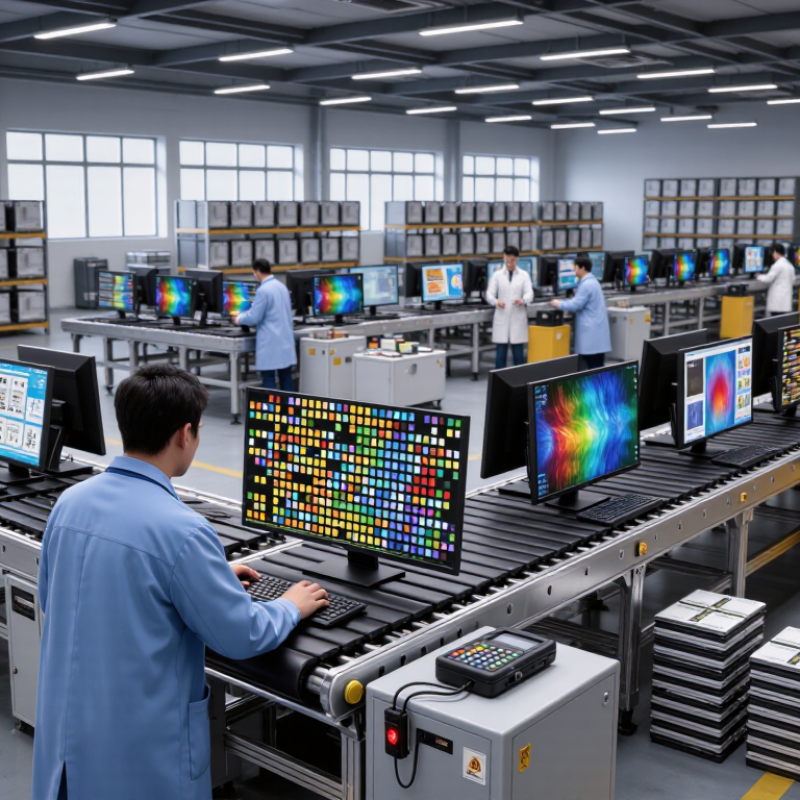
China’s PC screen manufacturing industry has become a major force in the global display supply chain. Its strength comes from dense supplier networks, large production capacity, and practical engineering experience. In manufacturing zones, panel materials, circuit boards, metal frames, and packaging services are often located within short delivery distances. This reduces coordination delays for international buyers.
Factory evaluations show wide differences between suppliers. Some manufacturers focus on high-volume office monitors, while others produce gaming displays, professional panels, or custom industrial screens. Reliable suppliers usually provide stable brightness testing, dead-pixel inspection, color calibration, and burn-in checks. They also explain panel sourcing clearly. That matters more than attractive specifications alone.
Quality can be inconsistent. Buyers should request production samples, inspection records, warranty terms, and replacement procedures before signing large orders. Technical documents should list resolution, refresh rate, response time, ports, power requirements, and operating temperature. Independent audits can reveal weak packaging or rushed assembly. Small details matter. A loose stand or poorly protected corner may create expensive claims after shipping. China’s global position is strong, but its reputation still depends on transparent communication, consistent quality control, and realistic delivery promises. Some suppliers improve quickly after feedback; others need closer supervision.
Key Types of PC Screens Made by Chinese Manufacturers
Chinese PC screen manufacturers produce several panel types for global buyers. The most common choice is IPS, valued for accurate colors and wide viewing angles. It suits design work, office use, and content creation. VA panels offer deeper contrast, making them useful for films, gaming, and dim rooms. TN panels remain affordable and fast, although their colors and viewing angles are weaker. They are still practical for budget-focused orders.
OLED screens deliver strong contrast and quick response times. However, buyers should examine burn-in policies, brightness limits, and long-term testing. Curved screens can improve immersion, but their value depends on size and viewing distance. Portable monitors, touch displays, and high-refresh gaming screens are also widely available. In supplier evaluations, I would inspect sample uniformity, dead-pixel control, ports, stands, and packaging strength. A polished sample may hide inconsistent production.
Tips: Request samples from the intended production line. Check brightness at several points, not only the center. Confirm color standards with measurement reports. Ask for aging-test records and clear warranty terms. Certification documents should match the exact model. Do not rely only on a factory presentation. Small details matter. Some buyers overlook cable quality and carton protection, then face avoidable complaints after shipment.cuntegn
Best PC Screen Manufacturers in China for Global Buyers
Key Types of PC Screens Made by Chinese Manufacturers
The chart compares representative native contrast ratios commonly associated with major PC display technologies. VA panels generally provide the highest contrast among conventional LCDs, IPS and TN panels typically offer around 1,000:1, while OLED screens can achieve extremely high contrast because each pixel emits its own light. Actual specifications vary by model, backlight, calibration, and manufacturer.
Reference basis: typical industry specifications for TN, IPS, VA, and OLED PC display panels; values are shown as representative comparisons rather than brand-specific data.
How to Evaluate Chinese PC Screen Manufacturers
Best PC Screen Manufacturers in China for Global Buyers?
How to Evaluate Chinese PC Screen Manufacturers
Choosing a Chinese PC screen manufacturer requires more than comparing online prices. Check its production history, engineering team, and quality-control process. Ask for factory photos, certification records, and recent customer references. A reliable supplier should explain panel types, brightness levels, refresh rates, color coverage, and warranty terms clearly.
Request a sample before signing a large order. Test it for dead pixels, uneven backlighting, port performance, viewing angles, and heat after several hours. Measure the screen with your own equipment when possible. Factory data can be accurate, but independent testing is safer. During factory visits, inspect the assembly line, aging-test area, packaging station, and spare-parts storage. I once trusted a polished sample too quickly. The bulk units showed weaker brightness. That mistake was expensive.
Tips: Compare three suppliers using the same specification sheet. Confirm minimum order quantities, lead times, payment stages, and inspection rights in writing. Ask how defective units are repaired or replaced. Check whether the manufacturer can adapt firmware, connectors, packaging, and regional power requirements. Review compliance documents for your destination market, and verify their issuing organizations independently. No checklist is perfect. Keep communication records, approve a sealed reference sample, and arrange pre-shipment inspection before payment. A supplier that welcomes measurable testing often deserves closer consideration.
Sourcing, Quality Control, and Import Considerations in China
China remains a major sourcing base for PC screens, but low prices require careful verification. UN Comtrade data identify China as the leading exporter of monitors under HS code 8528. However, supplier directories rarely show the full production picture. Request factory registration, production photos, test records, and recent export references. A video call helps, but it cannot replace an onsite audit.
Quality control should begin before production. Approve a golden sample with measured brightness, color accuracy, viewing angles, ports, stand movement, and pixel-defect limits. Use ISO 2859-1 sampling for shipment inspections. Test cartons through drop checks and inspect foam compression around corners. IDC’s Worldwide Quarterly PC Monitor Tracker reported a weak global monitor market during 2023, so suppliers may accept smaller orders or adjust components. That flexibility can help. It can also hide substitutions.
Tips:
Place an independent inspection before final payment. Confirm the HS code, country-of-origin documents, warranty terms, and packaging marks with a qualified customs broker. The World Bank’s 2023 Logistics Performance Index ranked China 19th among 139 economies, with a 3.7 score. Delivery is capable, but port delays and document errors still happen. Get freight quotes under the same Incoterm. Compare insurance, destination charges, and inspection costs. A spreadsheet can still lie by omission.