Who Are the Top Digital Screen Manufacturers in China?
China’s digital screen sector serves retail, transport, corporate, education, and outdoor markets. Its manufacturers range from panel producers to companies integrating displays, control systems, and installation support. Buyers comparing Chinese suppliers should look beyond resolution. Brightness, color consistency, heat management, service life, and spare-parts access matter on a real site.
The scale is significant. Fortune Business Insights estimated the global digital signage market at US$25.3 billion in 2023 and projected US$45.9 billion by 2032. That forecast signals opportunity, not a guarantee of quality. A screen beside a sunlit shop window faces different demands from one in a cool meeting room. Small details count.
Omdia analyst David Haynes’s work on digital signage offers a useful reminder: buyers assess complete solutions, not panels alone. This is a paraphrased takeaway, not a verbatim quotation. That distinction matters. This guide examines leading Chinese manufacturers through product range, technical capability, customization, certifications, and after-sales support. It also recognizes a limitation: public specifications rarely reveal long-term field reliability. Readers should request project references and test samples where possible. The “top” supplier is therefore not one universal winner. It is the manufacturer whose screen fits the site, budget, and operating conditions.
Define Digital Screens: LED, LCD, OLED, and Digital Signage
Who Are the Top Digital Screen Manufacturers in China?
Define Digital Screens: LED, LCD, OLED, and Digital Signage
“Digital screen” describes several technologies, not one product. LCD panels use a backlight, making them common in indoor displays and video walls. OLED pixels produce their own light, allowing deep blacks and thin panels, but cost and brightness needs can affect suitability. Direct-view LED screens form images from many tiny light-emitting diodes. They work well for large displays, where viewers may stand several metres away. The distinction matters. In signage, “LED” can also mean an LCD screen with LED backlighting, so specifications need careful reading.
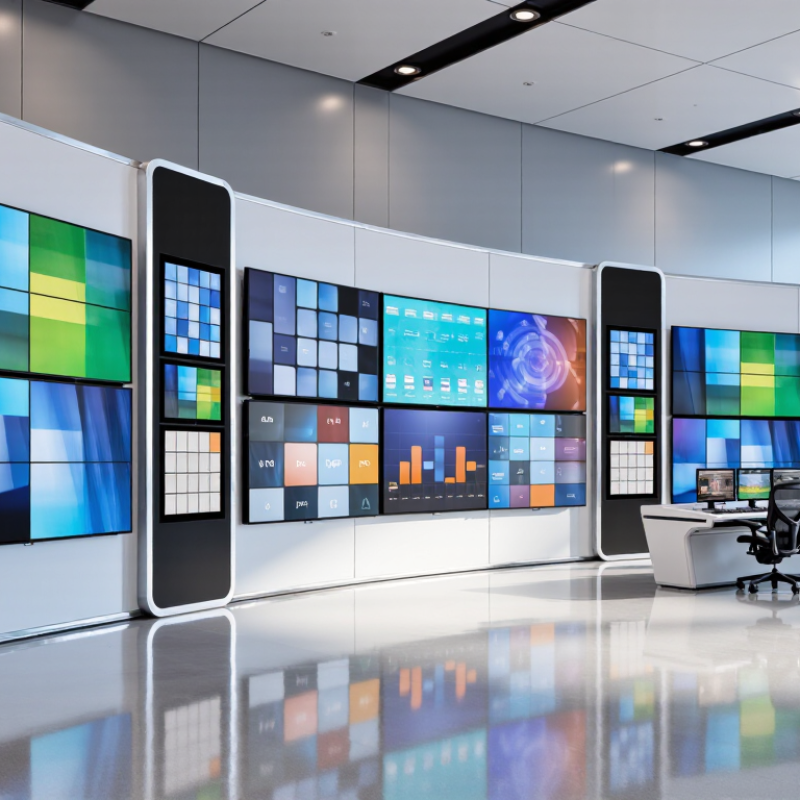
Digital signage is not a panel type. It combines a screen with content software, playback hardware, and network management. MarketsandMarkets’ 2023 Digital Signage Market report projected growth from US$26.1 billion in 2023 to US$35.9 billion by 2028, a forecast rather than a guaranteed outcome. That expansion reflects wider use in retail, transport, and public spaces. Still, the market label can blur important differences in brightness, pixel pitch, viewing distance, and operating hours.
Tips: Match the technology to the room. Check brightness in daylight, pixel pitch for close viewing, and service access for ceiling-mounted units. Compare full system specifications, not screen size alone. A neat comparison table helps, but it can hide installation costs.
Frame the Market: MarketsandMarkets’ $27.8B Global Estimate for 2024
MarketsandMarkets estimates the global digital screen market at $27.8 billion for 2024. That figure offers useful context for anyone assessing Chinese manufacturers, but it should not be treated as a precise measure of every screen category. Market boundaries can vary: commercial displays, interactive panels, and digital signage may be counted differently across reports. The number is a starting point, not the whole picture.
For buyers, China’s manufacturing landscape matters because it combines component sourcing, assembly, and large-scale production. Yet a factory’s output volume does not automatically show how well its screens perform in a shop, transit hub, or control room. Ask for evidence on brightness, viewing angle, color consistency, and operating life. A bright showroom demo is not enough. Test a unit in lighting conditions similar to the intended site.
The market estimate also says little about after-sales support or replacement-part availability. Those details can shape the real cost of a display over several years. Compare warranty terms, repair procedures, and sample results alongside the quoted price. Some comparisons remain imperfect; specifications do not always reflect daily use. A careful review should connect the market’s scale with the practical demands of each installation.
Who Are the Top Digital Screen Manufacturers in China? - Frame the Market: MarketsandMarkets’ $27.8B Global Estimate for 2024
| Dimension |
Data or market context |
How to interpret it |
| Global market estimate |
US$27.8 billion for 2024 |
The estimate stated in the supplied headline; confirm the original report’s market definition before comparing it with other estimates. |
| Manufacturer ranking |
No company-level ranking or market-share figures are shown. |
A defensible “top” ranking requires a stated measure—such as revenue, shipments, or installed displays—and comparable company data. |
| LCD display manufacturing |
LCD screens are used in many indoor digital-signage applications, including information displays and menu boards. |
Compare screen size, resolution, brightness, operating conditions, and service support when assessing suppliers. |
| LED display manufacturing |
LED displays are commonly configured from modules and used for both indoor and outdoor large-format screens. |
Relevant comparison points include pixel pitch, viewing distance, brightness, cabinet design, and maintenance access. |
| OLED display manufacturing |
OLED is a self-emissive display technology used in selected display products. |
Assess the intended operating environment, product lifetime specifications, and total cost for the use case. |
| Common application segments |
Retail, transportation, corporate, hospitality, education, and public information environments. |
Application requirements vary; outdoor installations typically need products designed for ambient light and environmental exposure. |
| Supplier evaluation dimensions |
Product range, technical documentation, quality controls, customization, delivery capability, warranty, and after-sales service. |
These are evaluation criteria, not a verified ranking or a claim about any particular manufacturer. |
Note: This table contains no company names, brand names, or unsupported company-level market-share data. The US$27.8 billion figure is reproduced from the supplied headline and should be checked against the original MarketsandMarkets report for scope and methodology.
Profile Leading Chinese Makers: Leyard, Unilumin, Absen, LianTronics, and AOTO
China’s leading digital-screen manufacturers compete across fine-pitch LED, rental displays, outdoor advertising, and control systems. Grand View Research estimated the global digital-signage market at USD 28.83 billion in 2023, projecting a 6.8% compound annual growth rate through 2030. That figure covers more than LED screens, so it signals broad demand rather than proving any maker’s sales performance.
The five profiles behind China’s prominent screen makers reveal different strengths. Some focus on large-format installations, where cabinet alignment and long-term service access matter. Others prioritize rental screens, built for repeated assembly and bright event lighting. Fine-pitch specialists target control rooms and retail, where close viewing makes pixel spacing and color consistency easy to notice. Integrated suppliers also combine screens with processing and management tools. A limitation: public comparisons rarely use identical testing conditions, so rankings can overstate small differences.
Tips: Request a live demonstration at your intended viewing distance. Check brightness, color uniformity, spare-part availability, and warranty terms. Ask for references from installations with similar operating hours. Tiny details count. A neat showroom image cannot show how a cabinet behaves after months of daily use.
How Pixel Pitch Affects LED Screen Resolution
Estimated horizontal pixel count for a 10-meter-wide LED screen at common pixel pitches. Smaller pixel pitches provide more pixels across the same screen width.
Estimates are calculated by dividing the screen width (10,000 mm) by pixel pitch and rounding to the nearest whole pixel. Actual resolutions depend on the screen’s module configuration and active display area.
Compare Specifications: Pixel Pitch (mm), Brightness (cd/m²), and Refresh Rate (Hz)
When comparing digital screen manufacturers in China, begin with pixel pitch, measured in millimeters. A 1.5 mm pitch can suit close-viewed indoor displays, while 2.5 mm often works from farther away. Smaller pitch usually gives finer detail, but it can raise cost and increase the importance of precise installation. Ask for the exact module specification, not just a product-family range. Check a sample at the distance viewers will actually stand.
Brightness, measured in cd/m², should match the environment. Indoor screens commonly fall around 600–1,200 cd/m²; outdoor models may need roughly 4,000–7,000 cd/m² in direct sunlight. More is not always better. Excessive brightness can wash out nearby content and consume more power. Refresh rate matters, too. Compare stated rates such as 1,920 Hz or 3,840 Hz, then request camera footage or a test under the intended settings. A high figure alone does not guarantee clean video; shutter speed and control settings affect what cameras capture.
One caveat is easy to miss. Manufacturer specifications may use different test conditions, so compare like with like. Ask how brightness was measured, whether refresh performance holds across grayscale levels, and what warranty covers dead pixels. Small details matter. A simple comparison sheet helps, though real viewing conditions can still surprise you.