Best Digital Screen Technologies for Stunning Visual Experiences
In the ever-evolving realm of visual technology, the significance of digital screens has reached unprecedented heights. According to a report by Markets and Markets, the global digital signage market is projected to grow from USD 25.7 billion in 2022 to USD 40.8 billion by 2027, at a CAGR of 9.5%. This staggering growth underscores the increasing reliance on digital screens for various applications, from advertising to entertainment and beyond. With advancements in display technologies such as OLED, microLED, and LCD, the pursuit of stunning visual experiences is more attainable than ever.
Industry expert Dr. Emily Chen, a leading authority in display technologies, emphasizes this trend, stating, "The evolution of digital screens not only enhances visual quality but also transforms the way consumers interact with content." As businesses and institutions recognize the power of captivating visual experiences, the demand for innovative digital screen solutions continues to rise. This introduction sets the stage for an in-depth exploration of the best digital screen technologies that are currently shaping the future of visual engagement and driving remarkable interactions across various sectors.
Overview of Digital Screen Technologies
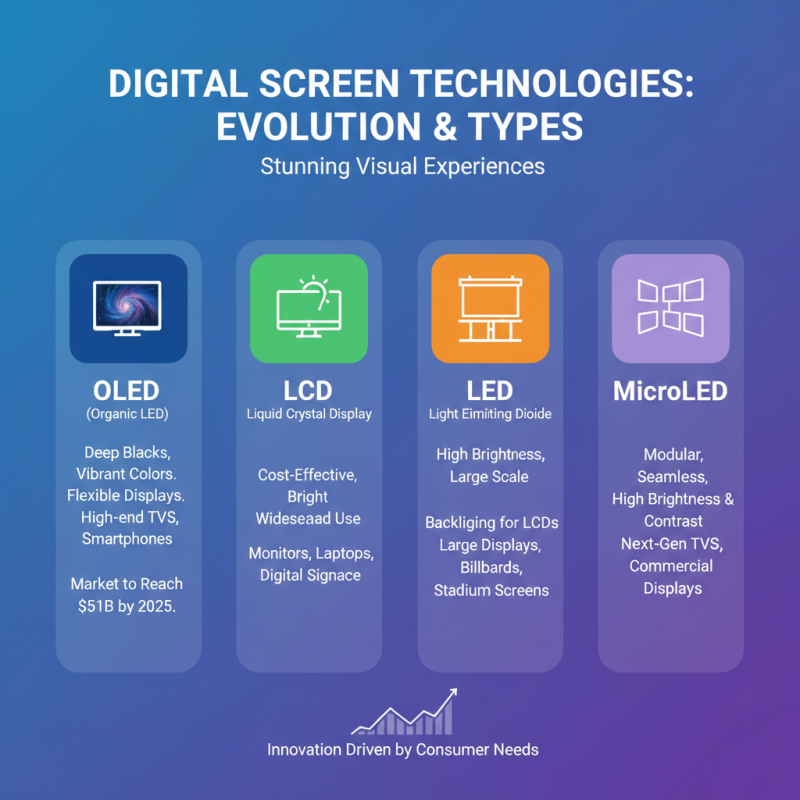
Digital screen technologies have evolved significantly over the past decade, providing consumers with stunning visual experiences that enhance everything from entertainment to professional presentations. The main types of digital screens include OLED, LCD, LED, and microLED. Each technology has distinct advantages, leading to various applications based on user needs. For instance, OLED screens are renowned for their ability to deliver deep blacks and vibrant colors, making them a favorite for high-end televisions, as noted in a recent study by MarketsandMarkets, which predicts the OLED market will reach $51 billion by 2025.
LCD technology, while slightly older, holds its own with improved backlighting and resolution capabilities. The global LCD market is forecasted to grow by more than 4% annually, showcasing ongoing advancements in display clarity and energy efficiency. For professional environments, LED screens see increased use due to their brightness and lower power consumption. The latest reports from the International Display Research Institute suggest that the LED market is expected to surpass $30 billion by 2026, driven by demand in advertising and event setups.
**Tip:** When choosing a digital screen, consider your primary use case. For vibrant colors and depth, opt for OLED; for cost-effective solutions, LCD may be sufficient. Furthermore, assess screen resolution to ensure a sharp image, especially for larger sizes.
**Tip:** Always check for energy efficiency ratings. A more efficient screen not only saves on power bills but also contributes to a greener environment. With significant advancements in screen technology, making an informed choice can lead to both stunning visual experiences and long-term savings.
Key Features of OLED Displays for Visual Quality
OLED displays have revolutionized the visual experience in recent years, primarily due to their exceptional contrast ratios and vibrant color accuracy. Unlike traditional LCD screens, OLED (Organic Light Emitting Diode) technology allows each pixel to emit its own light, resulting in deeper blacks and brighter colors without the need for a backlight. According to a recent industry report by the Display Industry Association, OLED panels are reported to achieve contrast ratios of over 1,000,000:1, significantly enhancing the viewing experience for users, especially in dark environments.
One of the key features of OLED is its ability to deliver faster response times compared to other display technologies. In fast-paced action scenes or games, OLED screens can switch between colors much more rapidly, reducing motion blur and enhancing clarity. A study from the Consumer Electronics Research Institute indicates that OLEDs can offer a response time of 0.01 milliseconds, which is a significant improvement over traditional displays. This feature, combined with the wider viewing angles provided by OLED technology, makes it a front-runner for immersive visual experiences.
**Tips:** To fully appreciate the advantages of OLED displays, consider viewing high-definition content that utilizes their full color and contrast capabilities. Additionally, ensure your viewing environment is dimly lit to experience the true depth and richness of the black tones that OLED is renowned for. If you're a gamer, prioritize OLED screens with high refresh rates for the best performance in competitive scenarios.
Visual Quality Comparison of Display Technologies
Comparative Analysis of LCD and LED Technologies
When considering digital screen technologies,
LCD and
LED are two prominent contenders that offer distinct advantages for visual experiences.
LCD (Liquid Crystal Display) technology is renowned for its ability to produce
vibrant colors and clear images, making it an ideal choice for applications such as computer monitors and televisions.
The use of backlighting in LCDs allows for better brightness and color consistency, providing a satisfactory experience for standard media consumption.
On the other hand, LED (Light Emitting Diode) technology has rapidly gained popularity due to its superior energy efficiency and thinner profile.
LEDs can achieve higher brightness levels and deeper contrasts compared to traditional LCDs,
enhancing the viewing experience especially in bright environments. Moreover, LED screens offer faster refresh rates, which are essential for dynamic content like gaming and sports,
ensuring smoother motion without ghosting.
Tips: When selecting between LCD and LED, consider the environment where the screen will be used.
For well-lit rooms, LED may be more beneficial for its brightness advantage. Additionally, check the refresh rate specifications if you plan on using the screen for gaming or fast-paced media.
Always take the time to compare color accuracy and view angles, as these factors will significantly impact your overall satisfaction with the display.
Emerging Innovations in MicroLED Screens
MicroLED technology represents a significant leap forward in display innovation, bringing together the best features of OLED and traditional LED screens while overcoming their limitations. This method utilizes microscopic light-emitting diodes to create images directly, which results in exceptional brightness, enhanced contrast ratios, and deeper blacks. As each pixel is individually lit, MicroLED screens can achieve incredible levels of precision in color representation, making them ideal for high-definition content and immersive viewing experiences.
Another key advantage of MicroLED technology lies in its scalability and flexibility. The modular nature of these displays allows for seamless integration into various screen sizes and configurations, catering to diverse applications from smartphones to large-scale installations. Furthermore, MicroLEDs are more energy-efficient and have a potentially longer lifespan compared to their OLED counterparts due to their inorganic materials, which significantly reduces the risk of burn-in issues. As this technology continues to evolve, it opens up exciting possibilities for future visual experiences that are more vibrant, durable, and adaptable than ever before.
Best Digital Screen Technologies for Stunning Visual Experiences - Emerging Innovations in MicroLED Screens
| Technology Type |
Resolution (pixels) |
Color Depth (bits) |
Brightness (nits) |
Refresh Rate (Hz) |
Contrast Ratio |
Lifespan (hours) |
| MicroLED |
3840 x 2160 |
10 |
2000 |
120 |
1,000,000:1 |
100,000 |
| OLED |
3840 x 2160 |
10 |
1000 |
60 |
100,000:1 |
100,000 |
| LCD |
1920 x 1080 |
8 |
300 |
60 |
1000:1 |
30,000 |
| QLED |
3840 x 2160 |
10 |
1500 |
120 |
150,000:1 |
50,000 |
| MiniLED |
3840 x 2160 |
10 |
2000 |
120 |
100,000:1 |
50,000 |
The Role of Resolution and Color Accuracy in Screen Performance
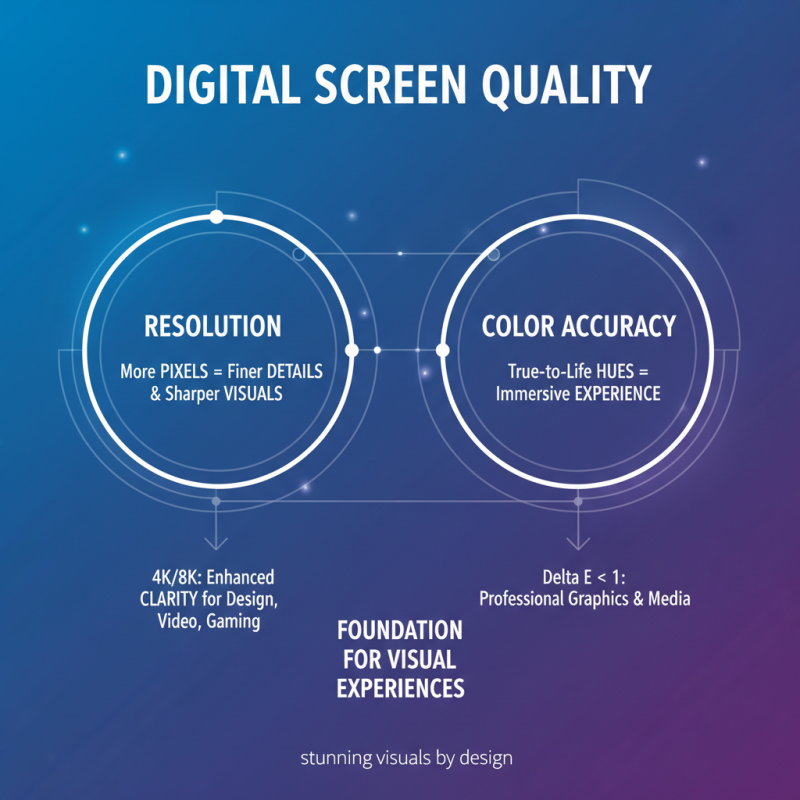
Resolution and color accuracy play pivotal roles in determining the quality of digital screens, creating the foundation for stunning visual experiences. Resolution refers to the number of pixels utilized to display an image; higher resolution means more pixels packed into the same screen size, resulting in finer details and sharper visuals. For instance, screens with 4K and 8K resolutions significantly enhance visual clarity, making it easier to perceive intricate details in images, video, and graphics. This high pixel density is particularly beneficial for activities such as graphic design, video editing, and gaming, where precision is crucial.
Equally important is color accuracy, which ensures that the colors displayed on a screen closely resemble the colors intended by the content creators. Screens with high color accuracy provide a broader color gamut, allowing for more vibrant and realistic images. Technologies such as quantum dots and OLED contribute to richer color reproduction and better contrast ratios, delivering an immersive viewing experience. The ability to see true-to-life colors can make a significant difference in applications ranging from digital art to film production, where visual fidelity is tantamount. Thus, the interplay between resolution and color accuracy is essential for achieving spectacular visual performance in modern displays.